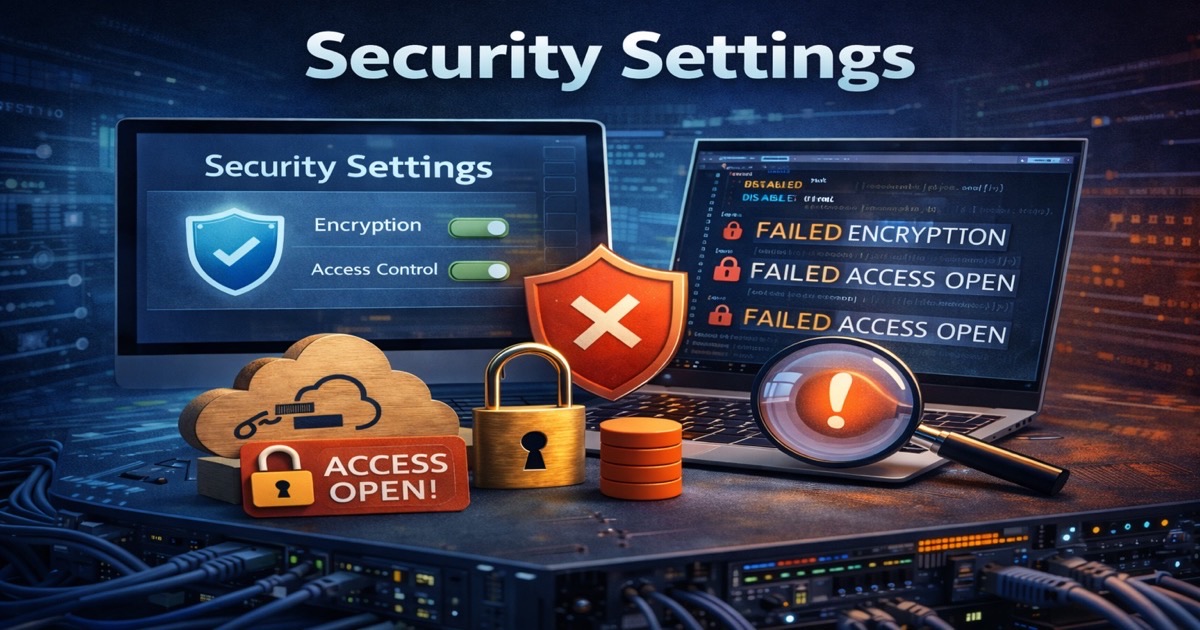
A cloud misconfiguration is an incorrect or suboptimal security setting in a cloud environment that creates vulnerabilities exploitable by attackers. Cloud misconfigurations are the leading cause of cloud data breaches - according to Gartner, 99% of cloud security failures through 2025 were the customer's fault, primarily due to misconfigurations such as publicly exposed storage buckets, overly permissive IAM roles, and unencrypted databases.
Unlike sophisticated zero-day exploits, misconfigurations are preventable errors that leave the door wide open. They occur across every major cloud provider - AWS, Azure, and Google Cloud - and affect organizations of every size. Understanding what misconfigurations are, why they happen, and how to prevent them is fundamental to any cloud security strategy.
Why Cloud Misconfigurations Happen
Cloud misconfigurations are rarely the result of a single failure. They emerge from a combination of organizational, technical, and human factors:
- Speed of deployment. Cloud makes it trivially easy to spin up resources. Teams prioritize shipping over security, and configurations that should be reviewed get pushed to production unchecked.
- Complexity of cloud services. A single AWS account can have hundreds of services, each with its own configuration surface. Azure and GCP are no different. The sheer volume of settings makes manual oversight impossible.
- Shared responsibility confusion. Many organizations still assume the cloud provider handles all security. In reality, the provider secures the infrastructure; the customer secures everything they build on top of it - data, access, network rules, and configurations.
- Human error. A developer toggles a storage bucket to public for testing and forgets to revert it. An admin copies an IAM policy with wildcard permissions from a Stack Overflow answer. These mistakes happen every day.
- Infrastructure as Code drift. Even when infrastructure is defined in Terraform or CloudFormation, manual console changes create drift between the declared state and the actual state, introducing misconfigurations that go undetected.
The 10 Most Common Cloud Misconfigurations
Based on real-world assessments across hundreds of cloud environments, these are the misconfigurations we encounter most frequently:
- Publicly accessible storage buckets. S3 buckets, Azure Blob containers, and Google Cloud Storage buckets exposed to the internet. This remains the single most common cause of cloud data leaks, despite all three providers now defaulting to private access.
- Overly permissive IAM policies. Wildcard permissions (
*:*) granted to roles, users, or service accounts. When a compromised identity has admin-level access, the blast radius is the entire account. - MFA not enforced for privileged accounts. Root accounts, global admins, and break-glass accounts without multi-factor authentication are a single password away from full compromise.
- Unencrypted data at rest. Databases, storage volumes, and backups stored without encryption. If an attacker gains access to the underlying storage, the data is immediately readable.
- Open security groups. Inbound rules allowing
0.0.0.0/0on SSH (port 22), RDP (port 3389), or database ports (3306, 5432, 1433). This exposes management interfaces to the entire internet. - Logging and monitoring disabled. CloudTrail, Azure Activity Logs, or GCP Audit Logs turned off or not forwarded to a central location. Without logs, breaches go undetected and incident response is blind.
- Legacy authentication protocols enabled. Older protocols like POP3, IMAP, and SMTP basic auth in Microsoft 365 and Entra ID bypass MFA and conditional access policies entirely.
- No network segmentation. Flat network architectures where every resource can communicate with every other resource. A single compromised workload leads to lateral movement across the entire environment.
- Unused credentials and stale access keys. Service account keys, API tokens, and user credentials that remain active long after they are needed. These dormant credentials are prime targets for attackers.
- Missing encryption key rotation. KMS keys, storage account keys, and secrets that are never rotated. Long-lived keys increase the window of exposure if a key is compromised.
The Cost of Cloud Misconfigurations
The impact of a cloud misconfiguration extends far beyond the technical remediation:
- Data breaches. IBM's Cost of a Data Breach Report puts the average cost of a cloud-related breach at $4.75 million. Misconfigurations are the most common initial attack vector in cloud breaches.
- Compliance fines. Regulatory frameworks like GDPR can impose fines of up to 4% of annual global turnover. HIPAA violations can reach $1.5 million per violation category per year. A single misconfigured database can trigger these penalties.
- Reputational damage. Customers, partners, and investors lose confidence when a breach is caused by a preventable configuration error. The narrative of "they left the door open" is far more damaging than "they were hit by a sophisticated attack."
- Operational disruption. Incident response, forensic investigation, legal review, and customer notification consume weeks or months of engineering and executive time.
How to Prevent Cloud Misconfigurations
Preventing misconfigurations requires a layered approach that combines tooling, process, and culture:
- CSPM tools for continuous monitoring. Cloud Security Posture Management (CSPM) platforms continuously scan your cloud environments against security benchmarks and compliance frameworks, flagging misconfigurations in real time. Learn more about CSPM.
- IaC scanning for pre-deployment checks. Tools like Checkov, tfsec, and KICS analyze Terraform, CloudFormation, and ARM templates for misconfigurations before they ever reach production. Learn more about IaC security.
- CI/CD pipeline security gates. Integrate security checks directly into your deployment pipeline. Block deployments that introduce public storage buckets, overly permissive IAM policies, or unencrypted resources.
- Least privilege enforcement. Start with zero permissions and grant only what is needed. Review and right-size IAM policies regularly. Eliminate wildcard permissions.
- Regular access reviews. Audit user accounts, service principals, and API keys on a scheduled basis. Remove stale credentials, disable unused accounts, and rotate keys that have exceeded their maximum age.
How SecValley Detects Misconfigurations
SecValley's cloud security posture management platform is purpose-built to find and prioritize misconfigurations across your cloud environment:
- 194 security controls across 12 analysis layers. Our assessment covers identity, access, network, data, logging, encryption, and more - mapping findings to CIS Benchmarks, SOC 2, ISO 27001, and other frameworks.
- Deep coverage for Microsoft 365, Entra ID, and Azure. We go beyond surface-level checks to analyze conditional access policies, legacy authentication, mailbox delegation, SharePoint sharing settings, and tenant-wide configurations.
- Agentless, read-only architecture. No agents to install, no write permissions required. SecValley connects with read-only access and completes a full assessment in under 5 minutes.
- Actionable remediation guidance. Every finding includes step-by-step remediation instructions, risk severity ratings, and compliance framework mapping so your team knows exactly what to fix and why.
Explore SecValley CSPM to see how we help organizations eliminate cloud misconfigurations.