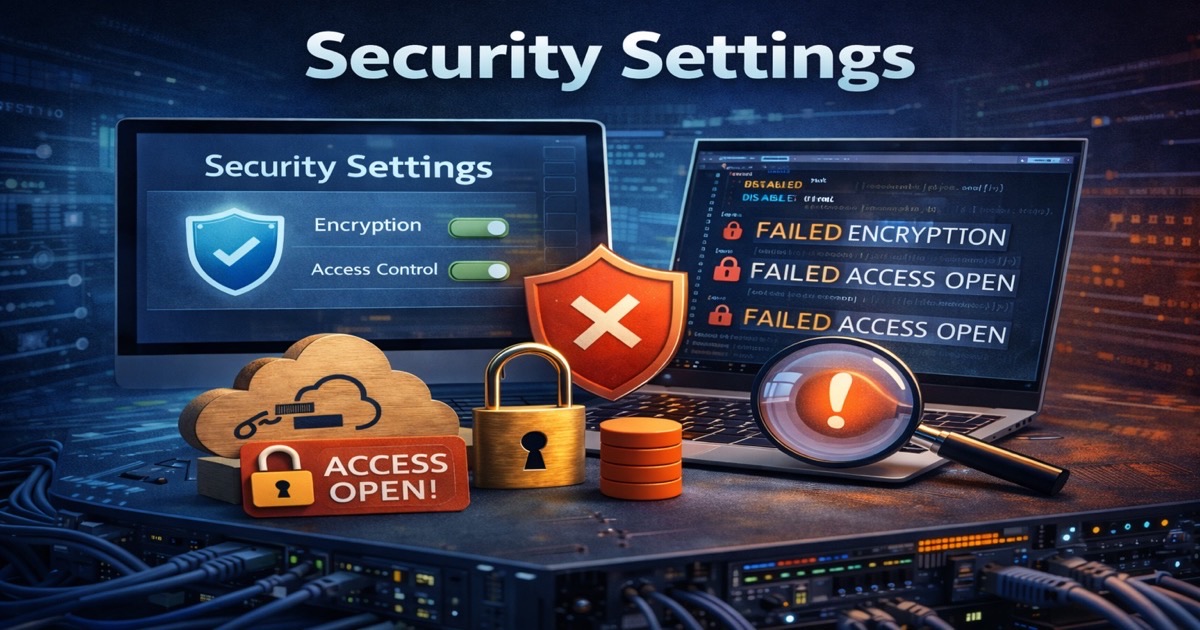
Cloud Security Posture Management (CSPM) is a category of security technology that automatically detects security misconfigurations in cloud environments, continuously monitors compliance posture against regulatory frameworks, and prioritizes security risks based on severity, exploitability, and business impact. CSPM tools scan cloud resources across providers like AWS, Azure, and GCP - as well as SaaS platforms like Microsoft 365 - to identify violations of security best practices and compliance standards such as CIS Benchmarks, SOC 2, ISO 27001, HIPAA, and GDPR.
According to Gartner, through 2025, 99% of cloud security failures were the customer's fault - primarily due to misconfigurations such as publicly exposed storage buckets, overly permissive IAM roles, and unencrypted databases. CSPM tools exist to automatically detect and remediate these misconfigurations before they can be exploited by attackers.
What Does CSPM Do?
CSPM tools serve as the security guardrails for cloud infrastructure. They continuously scan cloud environments and evaluate resource configurations against security best practices and compliance requirements. When a misconfiguration or policy violation is detected, CSPM tools alert security teams and - in many cases - can automatically remediate the issue.
At a high level, CSPM performs five core functions:
- Misconfiguration Detection - Identifies insecure configurations across compute, storage, network, identity, and data services
- Compliance Monitoring - Maps cloud configurations to regulatory and industry compliance frameworks
- Risk Prioritization - Scores and ranks findings based on severity, exploitability, asset value, and exposure
- Remediation Guidance - Provides step-by-step instructions or automated fixes for identified issues
- Continuous Visibility - Maintains an up-to-date inventory of cloud assets and their security posture over time
How Does CSPM Work?
Most modern CSPM tools operate using an agentless, API-based approach. Here's how the process typically works:
- Cloud Account Connection - The CSPM tool connects to cloud environments (AWS, Azure, GCP, Microsoft 365) via read-only API access. No agents need to be installed on individual resources.
- Resource Discovery - The tool automatically discovers and inventories all cloud resources: virtual machines, storage accounts, databases, IAM roles, network configurations, and more.
- Policy Evaluation - Each discovered resource is evaluated against a library of security policies (often hundreds of built-in checks). These policies codify best practices from CIS Benchmarks, cloud provider recommendations, and compliance requirements.
- Finding Generation - When a resource violates a policy, a finding is generated with details about the misconfiguration, its severity, affected resource, and remediation steps.
- Risk Scoring - Findings are prioritized based on multiple factors: severity level, exploitability, internet exposure, asset sensitivity, and compliance impact.
- Alerting & Reporting - Security teams are notified through integrations (Slack, email, SIEM) and can access dashboards, compliance reports, and trend analysis.
- Remediation - Teams can fix issues manually with guided instructions, or enable auto-remediation for specific policy violations.
This entire cycle typically runs on a scheduled basis (daily, weekly, or continuously), ensuring that new misconfigurations are caught shortly after they're introduced.
Core CSPM Capabilities
Misconfiguration Detection
The primary function of any CSPM tool. Common misconfigurations detected include:
- Publicly accessible storage buckets (S3, Azure Blob, GCS)
- Unencrypted databases (RDS, Azure SQL, Cloud SQL)
- Overly permissive IAM roles and policies
- Open security groups and network ACLs
- MFA not enforced for privileged accounts
- Legacy authentication protocols still enabled
- Logging and monitoring not configured
- Encryption at rest or in transit not enabled
Attack Path Analysis
Advanced CSPM tools go beyond individual misconfigurations to visualize how multiple issues could be chained together by an attacker. For example, an overly permissive IAM role combined with a publicly exposed VM and an unencrypted database might create a critical attack path to sensitive data - even though each individual misconfiguration might be rated as "medium" severity on its own.
Compliance Mapping
CSPM tools map security findings to specific controls within compliance frameworks. This allows organizations to see their compliance posture at a glance and generate audit-ready reports. A single misconfiguration might violate controls across multiple frameworks simultaneously.
Asset Inventory
Automatic discovery and classification of all cloud resources. This provides visibility into what's actually running in the environment - often revealing shadow IT, forgotten resources, and unexpected exposure.
Security Posture Scoring
Most CSPM tools provide an overall security posture score (typically 0-100) that tracks improvement or regression over time. This metric is valuable for executive reporting and measuring the effectiveness of security investments.
Automated Remediation
Some CSPM tools offer auto-remediation capabilities - automatically fixing misconfigurations when they're detected. This is typically configurable per policy, as some fixes may have operational impact.
Why CSPM Matters
Cloud environments are dynamic - resources are created, modified, and deleted constantly. Manual security reviews cannot keep pace with the speed of cloud deployment. CSPM matters because:
- Scale: A typical enterprise has thousands of cloud resources. Manual review is impossible.
- Speed: Infrastructure-as-Code (IaC) enables developers to deploy resources in seconds. A misconfiguration can be introduced and exploited faster than a manual audit cycle.
- Complexity: Multi-cloud environments, dozens of cloud services, and hundreds of configuration options create a vast attack surface.
- Compliance: Regulatory requirements (SOC 2, HIPAA, GDPR) demand continuous evidence of security controls - not annual snapshots.
- Shared Responsibility: Cloud providers secure the infrastructure; customers are responsible for configuration. CSPM ensures customers fulfill their side of this model.
Key Statistics
- 99% of cloud security failures are the customer's fault (Gartner)
- Cloud misconfigurations are the #1 cause of cloud data breaches
- The average enterprise has 3,500+ cloud misconfigurations at any given time
- 68% of organizations experienced a cloud security incident in the past 12 months
CSPM vs CWPP: What's the Difference?
| Aspect | CSPM | CWPP |
|---|---|---|
| Focus | Cloud infrastructure configuration | Running workload security |
| What it protects | Cloud resources (storage, network, IAM, databases) | Workloads (VMs, containers, serverless) |
| Approach | Prevention-oriented (find and fix before exploitation) | Detection & response (protect running workloads) |
| Agent requirement | Typically agentless (API-based) | Often requires agents on workloads |
| Key capabilities | Misconfiguration detection, compliance monitoring | Vulnerability scanning, runtime protection, malware detection |
| When to use | Securing cloud infrastructure and ensuring compliance | Protecting applications and workloads at runtime |
Bottom line: CSPM and CWPP are complementary. CSPM secures the foundation (infrastructure configuration), while CWPP protects what runs on top (workloads). Most mature organizations use both.
CSPM vs CASB: What's the Difference?
| Aspect | CSPM | CASB |
|---|---|---|
| Focus | Cloud infrastructure security | SaaS application security |
| What it monitors | Cloud resource configurations | User activity in SaaS apps |
| Primary use case | Misconfiguration & compliance | Shadow IT, DLP, access control |
| Deployment | Connects to cloud provider APIs | Inline proxy or API-based |
CSPM focuses on how cloud infrastructure is configured; CASB focuses on how users interact with SaaS applications.
CSPM vs CIEM: What's the Difference?
CIEM (Cloud Infrastructure Entitlement Management) is a specialized category focused exclusively on managing cloud identities and permissions. While CSPM includes some identity checks (like detecting overly permissive IAM roles), CIEM goes much deeper into identity analytics, least-privilege enforcement, and permission right-sizing.
| Aspect | CSPM | CIEM |
|---|---|---|
| Scope | Broad (all cloud configurations) | Narrow (identity & permissions only) |
| Identity depth | Basic IAM checks | Deep entitlement analysis, permission mining |
| Primary output | Misconfigurations & compliance gaps | Least-privilege recommendations |
Many modern CSPM platforms are incorporating CIEM capabilities, and CNAPP platforms typically include both.
CSPM's Role in CNAPP
CNAPP (Cloud-Native Application Protection Platform) is Gartner's term for a unified platform that combines multiple cloud security capabilities. CSPM is a foundational component of every CNAPP solution.
A typical CNAPP includes:
- CSPM - Infrastructure configuration security and compliance
- CWPP - Workload and runtime protection
- CIEM - Identity and entitlement management
- IaC Scanning - Security checks for Terraform, CloudFormation, etc.
- Container Security - Image scanning and registry protection
- API Security - API discovery and protection
If your organization is evaluating a CNAPP, the quality of its CSPM component is one of the most important factors - since misconfigurations remain the #1 cause of cloud breaches.
Compliance Frameworks Supported by CSPM
CSPM tools map cloud configurations to controls within regulatory and industry compliance frameworks. The most commonly supported frameworks include:
| Framework | Focus | Who Needs It |
|---|---|---|
| CIS Benchmarks | Hardening best practices per cloud platform | All organizations (foundation) |
| SOC 2 Type II | Trust service criteria (security, availability, confidentiality) | SaaS companies, service providers |
| ISO 27001 | Information security management system | International organizations, enterprises |
| HIPAA | Healthcare data protection | Healthcare, health tech |
| PCI-DSS | Payment card data security | E-commerce, fintech, payment processors |
| NIST 800-53 | Federal security controls | US government, government contractors |
| GDPR | EU data protection | Any organization processing EU citizen data |
| KVKK | Turkish personal data protection | Organizations operating in Turkey |
Most Common Cloud Misconfigurations
Based on real-world data from CSPM deployments, these are the most frequently detected misconfigurations:
- Publicly accessible storage - S3 buckets, Azure Blob containers, or GCS buckets exposed to the internet
- Overly permissive IAM policies - Wildcard permissions (Action: *, Resource: *) or admin access granted broadly
- MFA not enforced - Root accounts, privileged users, or service accounts without multi-factor authentication
- Unencrypted data at rest - Databases, storage accounts, and volumes without encryption enabled
- Open security groups - Inbound rules allowing 0.0.0.0/0 on sensitive ports (SSH, RDP, databases)
- Logging disabled - CloudTrail, Azure Activity Logs, or GCP Audit Logs not enabled or not centralized
- Legacy authentication enabled - Older authentication protocols that bypass modern security controls like MFA
- No network segmentation - Flat network architectures without proper subnet isolation
- Unused credentials - Active access keys, service accounts, or API tokens for departed employees or decommissioned services
- Missing key rotation - Encryption keys and access credentials not rotated within policy timeframes
How to Evaluate CSPM Tools: 10 Criteria
When selecting a CSPM tool for your organization, evaluate against these criteria:
- Cloud platform coverage - Which providers are supported? (AWS, Azure, GCP, Microsoft 365, Entra ID)
- Depth of security controls - How many built-in policies? How deep is the analysis? (Surface-level checks vs. contextual analysis)
- Compliance framework support - Which frameworks are mapped? (CIS, SOC 2, ISO 27001, HIPAA, PCI-DSS, GDPR)
- Attack path analysis - Can the tool visualize how misconfigurations chain together?
- Deployment model - Agentless vs. agent-based? How fast is setup?
- Remediation capabilities - Guided remediation? Auto-remediation? IaC fix suggestions?
- Integration ecosystem - SIEM, ticketing (Jira, ServiceNow), messaging (Slack, Teams), CI/CD pipeline
- Reporting quality - Technical reports for engineers, executive summaries for leadership, compliance reports for auditors
- Multi-tenant support - Can you manage multiple organizations from a single console? (Important for MSPs and enterprises)
- Pricing model - Per-asset, per-account, per-user, or flat-rate? Transparent pricing vs. "contact sales"?
Best CSPM Tools in 2026
The CSPM market includes both standalone platforms and CSPM capabilities within broader CNAPP solutions. Here are the leading options:
| Tool | Best For | Key Strength |
|---|---|---|
| SecValley | Microsoft 365, Entra ID & Azure environments | Deepest Microsoft ecosystem coverage (Exchange, SharePoint, Teams, Entra ID) + expert advisory services. 194 controls, attack path analysis, agentless in under 5 minutes. |
| Wiz | Multi-cloud IaaS (AWS, Azure, GCP) | Agentless graph-based security with deep IaaS analysis across all major cloud providers. |
| Prisma Cloud (Palo Alto) | Enterprise CNAPP | Comprehensive CNAPP with CSPM, CWPP, CIEM, and code security in a single platform. |
| Orca Security | Agentless cloud security | SideScanning technology for agentless workload and configuration assessment. |
| Prowler | Open source AWS/Azure/GCP | Open-source security tool with 300+ checks. Free and community-driven. |
| AWS Security Hub | AWS-native | Native AWS service that aggregates findings from multiple AWS security services. |
| Microsoft Defender for Cloud | Azure-native | Native Azure CSPM with Secure Score, regulatory compliance dashboard, and Defender plans. |
When choosing a CSPM tool, consider your primary cloud environment. For organizations heavily invested in the Microsoft ecosystem (Microsoft 365, Entra ID, Azure), SecValley provides the deepest coverage of the entire Microsoft stack. For multi-cloud IaaS environments, tools like Wiz or Prisma Cloud offer broader infrastructure coverage.
Frequently Asked Questions
What is CSPM?
Cloud Security Posture Management (CSPM) is a category of security technology that automatically detects security misconfigurations in cloud environments such as AWS, Azure, and GCP, continuously monitors compliance posture against frameworks like SOC 2 and ISO 27001, and prioritizes security risks based on severity, exploitability, and business impact.
What is the difference between CSPM and CWPP?
CSPM focuses on cloud infrastructure configuration security (preventing misconfigurations), while CWPP focuses on protecting running workloads (containers, VMs, serverless) at runtime. CSPM is prevention-oriented; CWPP is detection and response-oriented. Most mature organizations use both.
What is the difference between CSPM and CNAPP?
CNAPP (Cloud-Native Application Protection Platform) is a broader category that combines CSPM, CWPP, CIEM, and other capabilities. CSPM is a core component within CNAPP, specifically handling infrastructure configuration security and compliance monitoring.
Why is CSPM important?
99% of cloud security failures are the customer's fault, primarily due to misconfigurations (Gartner). Cloud environments change constantly, and manual security reviews cannot keep pace. CSPM provides automated, continuous visibility and enforcement of security best practices.
What compliance frameworks do CSPM tools support?
Most CSPM tools support CIS Benchmarks, SOC 2 Type II, ISO 27001, HIPAA, PCI-DSS, NIST 800-53, and GDPR. Some tools also support regional frameworks like KVKK and industry-specific standards.
Is CSPM only for large enterprises?
No. Any organization using cloud services benefits from CSPM. Small businesses and startups are often more vulnerable because they lack dedicated security teams. Modern CSPM tools like SecValley offer simplified one-click assessments designed for organizations without deep security expertise.
How much does CSPM cost?
CSPM pricing varies widely. Open-source tools like Prowler are free. Cloud-native tools (AWS Security Hub, Microsoft Defender for Cloud) have usage-based pricing. Commercial platforms range from a few hundred dollars per month for small businesses to custom enterprise pricing. Most vendors offer free trials or freemium tiers.
Can CSPM replace manual security audits?
CSPM complements but does not fully replace manual security audits. CSPM provides continuous automated checking of cloud configurations, while manual audits address process, governance, and areas that automated tools cannot cover. Together, they provide comprehensive security assurance.